
Japanese Pottery: A Sourcing Guide for Overseas Buyers
更新日:4 日前
You want to source Japanese pottery. You start researching, and the first thing you find is a list of regions: Arita, Kutani, Mino, Kyoto. Explanations of their history and techniques are everywhere.
What is almost never written down is the information you actually need to place an order. Which region to approach is not determined by the region's characteristics. It is determined by where you sell. The same "Japanese ceramic" behaves differently in a fine-dining kitchen, on a gallery shelf, and in an e-commerce warehouse. The region changes, the counterpart you negotiate with changes, and the regulations you must satisfy change.
There is a second thing specific to Japanese pottery: a single piece passes through several separate businesses before it is finished. If you approach one "kiln" without understanding this division of labour, your quotation, your lead time, and the ownership of quality issues will all hit a dead end partway through.
This guide does not start with the regions. It starts with your sales channel, then covers who to actually talk to, and then the practical layer: food-contact regulations by destination, HS codes, order quantities and lead times, and what to verify before you commit.
Start with your channel, not the region
The first question most buyers ask is "which region is best?" There is no answer to that question.
Japanese ceramic regions have genuinely different production structures. A workshop making one-of-a-kind pieces and a factory firing tens of thousands of units per month differ in price, lead time, minimum order and, crucially, in who you negotiate with. Neither is superior. The question is which one your channel requires.
Reverse the order and this is what happens: you fall in love with a region, enter negotiations, and discover that the order quantity does not work, the lead time cannot be committed to, or repeat supply of the identical item is impossible.
Settle these four points first.
Your sales channel (restaurant, gallery, retail, e-commerce, corporate gifting)
Order size per purchase order, and reorder frequency
Whether you need repeat supply of the identical item, or whether one-of-a-kind pieces are acceptable
Target retail price band
Once these are fixed, both the candidate regions and the right counterpart narrow down on their own.
Matching regions to your business
Fine dining and hotels
What matters is form that does not compete with the food, and pieces your competitors do not have. At the same time, as commercial tableware, you need to be able to replace a piece when it breaks. This is where one-of-a-kind pieces collide with operational reality.

Fig. 1 — Suitability by channel, based on production structure and typical order patterns. Kyoto covers four of the five channels, which reflects the breadth of its production, not a ranking of quality.
The workable approach is to agree, in the first negotiation, that the series will remain in production for a defined period.
Regions to look at: Kyoto (Kiyomizu / Kyo ware), Kutani
Galleries and craft retailers
Here the maker's identity and the story behind the piece are the value. Repeat supply of the identical item is not required; being one-of-a-kind is the selling point. Unit prices are the highest of any channel.
Because you are selling under the maker's name, a direct relationship with the artist or workshop matters.
Regions to look at: Kyoto (Kiyomizu / Kyo ware), Kutani
Select shops and lifestyle retail
Mid-price, workable lot sizes, and products that can rotate seasonally. The usual structure is to split your range into a permanent line and a seasonal line.
Regions to look at: Arita, Kyoto (Kiyomizu / Kyo ware), Mino
Bridal and corporate gifting
Unit price, presentation boxes, and a defensible explanation of "made in Japan" are the value. Volumes come in blocks but tend to be one-off, and lead times are usually comfortable.
Regions to look at: Kyoto (Kiyomizu / Kyo ware), Kutani
Volume retail and e-commerce
Price and inventory stability come first. You need a supply structure that can deliver the same SKU continuously.
Region to look at: Mino
The regions, in practical terms
The order below is not a ranking. Regions are listed from the widest range of channels served to the narrowest.
Kyoto (Kiyomizu ware / Kyo ware)
This region serves the widest range of channels. Of the five channel types above, Kyoto covers four: fine dining, galleries, select shops, and bridal and corporate gifting.
Kyoto's production structure differs from other regions in one decisive way. According to the Association for the Promotion of Traditional Craft Industries, Kyoto ceramics have never been mechanised, and roughly 90 percent of production is handmade. The two reasons given are that the work is divided among specialists, and that it is carried out in a cottage-industry manner in workshops attached to homes. On the lanes off Gojozaka, nameplates reading "potter's wheel craftsman" or "overglaze painter" hang beside the household nameplates.
This structure produces small volumes across many varieties, one-of-a-kind pieces, and made-to-order work. Reading this as "hard to source from" is a mistake. It means the region can make what others cannot. It is precisely the property galleries want, and precisely why a hotel can commission tableware no other hotel has.
Kyoto has no clay or ceramic stone of its own. Potters bring in clay from across Japan and blend it to their own formulations. There is no fixed clay, glaze or technique, which is why the region is often described as having as many styles as it has potters. In place of a standardised regional output, you get an unusually wide range of achievable designs.
Four models make small-batch and one-of-a-kind work viable for export:
Made to order — you place the order after your customer commits. Zero inventory risk, in exchange for asking your customer to accept the lead time
Series-level continuity agreement — fix the design and agree a defined production period. Effective for hotels and restaurants
One-of-a-kind gallery sales — price each piece individually and sell it with the maker's information
Corporate gift programmes — lock quantity and delivery date before production begins
For the wider picture on positioning Japanese crafts abroad, see Selling Japanese Traditional Crafts in Taiwan and Asia.
Arita ware
A porcelain region, and the historical starting point of Japanese ceramic exports.
Porcelain stone was discovered at Arita in the early 17th century, and Japan's first porcelain production began there. The first recorded export of Japanese porcelain was in 1647, carried by a Chinese vessel to Cambodia. When the Ming-Qing transition disrupted Chinese porcelain exports, the Dutch East India Company sought an alternative supplier, and full-scale export to Europe began in 1659 from Dejima in Nagasaki. Between the 1650s and the 1740s, tens of thousands to hundreds of thousands of pieces reached Europe via the port of Imari.
In other words, this region has close to four hundred years of accumulated experience designing for overseas markets. The basic proposition of putting a Japanese vessel on a Western table has already been tested here.
Practically, the defining property is that it is porcelain: thinner, harder and less porous than earthenware, which makes it easier to handle as commercial tableware and more tolerant of washing and stacking.
There is an important point on minimum quantities. According to an Arita OEM supplier, low-price regions tend to produce in single large runs, which pushes minimum orders into the thousands, whereas Arita work is handled by craftspeople at each stage and is commonly produced in batches of tens or hundreds of pieces. The intuition that "handmade regions cannot do small batches" is, in practice, backwards.
Kutani ware
Distinguished by polychrome overglaze painting, and among the most decorative of the regions. Unit prices skew high, which fits gifting well.
Kutani OEM kilns typically split incoming work into two tracks:
Decoration-only OEM — apply your design to existing forms. Shorter lead time, lower cost
Full OEM from form design — mould design, prototyping and production
Concrete figures are published for moulds. One Kutani kiln states that mould costs are quoted individually from around JPY 50,000, that a prototype mould stops producing usable pieces after roughly 30 units, and that for production runs of 100 or more they recommend commissioning a production mould rather than repeatedly making prototype moulds at JPY 20,000 or more per set.
The 30-unit limit on prototype moulds is a genuinely useful planning threshold: below about 30 pieces a prototype mould suffices; above 100 you should be budgeting for a production mould.
Decoration method also drives cost directly:
Hand painting — no plate or screen cost. Suits small batches. Not suitable if you require uniform decoration across units
Spray application — special colours are quoted at roughly JPY 5,000 to 12,000 per colour. Higher throughput and shorter lead times
Transfer printing — a plate cost applies. Produces uniform decoration at volume
Hand painting for galleries, transfer printing for volume retail. When you request a quotation, specify the form and the decoration method separately: the same form will carry a different price, lead time and minimum quantity depending on how it is decorated.
Mino ware
Japanese government statistics show Gifu Prefecture accounting for roughly 54 percent of national production value in ceramic tableware (2021, Economic Structure Survey, METI: JPY 19.71 billion of a national JPY 36.61 billion). The 2019 industrial statistics put the figure at 51.4 percent. Mino ware is the collective name for ceramics produced in the Tono area of Gifu, including Tajimi, Toki and Mizunami.
Note that if you widen the denominator to all ceramics, including tiles and sanitary ware, the share falls to around 43 percent (2013 industrial statistics). Figures of "50 percent" and "60 percent" both circulate for Mino's share. Before comparing them, check whether the source means tableware or all ceramics, and production value or unit volume.
The price range is wide, and the region has the structure to supply the same SKU continuously, which makes it the realistic choice where inventory stability is the priority.
That said, being able to produce volume is not the same as being cheap. Mino also produces high-value studio and commissioned work, and the region cannot be characterised by a single price band.
Who to buy from: the division of labour behind Japanese pottery
Why one kiln does not complete the job
Japanese ceramic regions are organised by function, with separate businesses handling separate stages. A Kyoto ceramics merchant describes the defining feature of Kyo and Kiyomizu ware as pieces moving between several kilns while passing through the hands of multiple craftspeople. The sequence runs: forming, trimming, underglaze painting, glazing, overglaze painting, firing. Where gold or silver decoration is applied, painting and firing are repeated several times over.

Fig. 2 — The production sequence and the separate businesses feeding it. Source: Association for the Promotion of Traditional Craft Industries; published process descriptions from Kyoto ceramics merchants and the Kiyomizu-yaki Danchi Cooperative.
The membership of the Kiyomizu-yaki Danchi cooperative makes the same point: it lists wholesalers, kilns, individual artists, raw-material suppliers, cabinet makers and doll makers as separate member businesses.
This is not unique to Kyoto. An Arita OEM supplier describes prototyping as work carried out in coordination with the mould maker, the glaze supplier and the kiln. Those are three different companies.
Three consequences for buyers:
Long lead times are structural, not negligence. Work passes through multiple businesses, and some decoration requires repeated firing
Quotation, delivery date and responsibility for quality are split across stages. Decide at the outset who coordinates the whole
This is exactly why wholesalers and trading companies exist. A regional cooperative includes wholesalers because someone has to hold the division of labour together
Buying direct from artists and workshops
Price: no intermediary margin
Information: direct access to the maker's background, technique and intent
Weakness: you handle export documentation, English communication and coordination across stages yourself. Smaller workshops may have no export experience
Suits galleries, one-of-a-kind work, and any programme where the brand story is the product.
Buying from a regional wholesaler
Price: a margin applies
Information: cross-regional proposals spanning multiple kilns
Order size: lower, because stock is held
Strength: accustomed to coordinating the division of labour, export paperwork, inspection and consolidation
Suits buyers sourcing across several regions or kilns, and anyone building a supply route for the first time.
Buying from an OEM kiln
Some kilns take work from mould design through to production. This is the route if you want an original form. Mould cost, prototype mould life and decoration method all feed directly into your unit cost, so state your intended order quantity in the first conversation. The quantity determines whether decorating an existing form is sufficient or whether a mould should be cut.
Buying through an export trading company
Price: the highest of the four
Strength: regulatory compliance, testing, documentation and logistics handled in one place
Weakness: the greatest distance from the maker
Choosing your counterpart
Where the maker's identity carries commercial value, going direct to the artist or workshop is the stronger position. Where you are rotating many SKUs through retail or e-commerce, a wholesaler makes the operation work. In practice the same buyer uses different counterparts for different lines. If you are appointing a partner on the ground, see How to Find and Choose an Overseas Agent.

Fig. 3 — Comparison of the four routes to supply. The right choice varies by product line, and most buyers use more than one.
Food-contact regulations by destination
Import tableware and it is regulated as a food-contact article. For ceramics the issue is primarily the migration of lead and cadmium: components in the glaze and overglaze enamel can leach into acidic food, and the permitted quantities are regulated. The structural implication is that the more decorated the piece, the higher the priority of verification.
The following reflects the position as of August 2026. Rules change; confirm against primary sources before you order.
United States
FDA Compliance Policy Guide Sec. 545.450 covers lead and Sec. 545.400 covers cadmium. The FDA classifies items and sets an action level for each class.

Fig. 4 — Source: FDA Compliance Policy Guide Sec. 545.450 (lead). Cadmium is covered separately under Sec. 545.400. An action level is not a safe limit; it is the threshold above which the FDA may take regulatory action. As of August 2026.
Lead action levels:
Flatware: 3.0 μg/mL
Small hollowware, excluding cups and mugs: 2.0 μg/mL
Cups and mugs: 0.5 μg/mL
Large hollowware, excluding pitchers: 1.0 μg/mL
Pitchers: 0.5 μg/mL
The class definitions matter as much as the numbers. Flatware means an internal depth of 25 mm or less, measured from the lowest point to a horizontal plane through the upper rim. Above 25 mm the item is hollowware: small below 1.1 litres, large at 1.1 litres and above. Cups and mugs are small hollowware for beverages, typically around 240 ml with a handle, cups having curved sides and mugs being cylindrical.
One point is regularly missed: creamers, coffee pots and teapots are not pitchers. They are classified as small or large hollowware by capacity. If you are sourcing kyusu teapots, getting this wrong means testing against the wrong class from the start. See Sourcing Japanese Teaware and Kyusu for the teapot-specific detail.
Note also that an action level is not a safe limit. It is the threshold above which the FDA may take regulatory action.
Finally, decorative ceramics are still regulated as food-contact articles unless they are explicitly identified as not for food use. Where that applies, a permanent statement such as "Not for Food Use. Glaze contains lead. Food Use May Result in Lead Poisoning" must be fired or painted onto the exterior base.
European Union
Council Directive 84/500/EEC, as amended by Commission Directive 2005/31/EC, governs ceramics, under the framework of Regulation (EC) No 1935/2004.
Migration limits:
Hollowware under 3 litres: lead 4.0 mg/L, cadmium 0.3 mg/L
Hollowware over 3 litres: lead 1.5 mg/L, cadmium 0.1 mg/L
Flatware: lead 0.8 mg/dm², cadmium 0.07 mg/dm²
Testing uses 4% (v/v) acetic acid at 22±2°C for 24±0.5 hours. Vessels and lids are tested separately, with the combined migration required to fall within the limit.
A written Declaration of Compliance is required. Under 2005/31/EC it is issued by the manufacturer or by a seller established within the EU, and must carry the particulars set out in Annex III, including the name and address of both the company that manufactured the finished article and the importer bringing it into the EU. The declaration must accompany the goods at each marketing stage up to and including retail, but not at the point of sale to the final consumer.
The practical implication: the declaration can be issued by either side, but only the manufacturer can produce the underlying test data. Agree before you order who retains the supporting evidence in case an authority asks for it.
Singapore
The Sale of Food Act (Cap 283) and the Food Regulations made under it apply, and ceramic tableware falls within the scope as a food appliance.
The operative provision is Regulation 37 (Containers for food), which prohibits containers that yield lead, antimony, arsenic, cadmium or other injurious substances to food stored or prepared in them. It is a general prohibition.
No numerical migration limits are prescribed, and the Food Regulations do not set labelling requirements for food-contact materials, though the authority retains power to recall misbranded or misrepresented products.
The absence of numbers does not mean the requirement is light. Because the basis for judging compliance is not written down, the importer carries the burden of being able to demonstrate safety. In practice that means testing against an internationally accepted standard such as EN, ASTM or ISO, and retaining the report.
Procedurally there are firm requirements. Importers must register with the Singapore Food Agency in advance, which requires obtaining a UEN from ACRA and activating it with Singapore Customs via TradeNet. All imported food-contact materials are subject to inspection at the port, and the SFA may draw samples for testing.
Malaysia
New rules took effect on 1 August 2026.
On 30 January 2026 the Ministry of Health gazetted the Food (Amendment) Regulations 2026 (P.U. (A) 48), amending Regulation 28 (ceramic ware) and the Thirteenth Schedule of the Food Regulations 1985, made under the Food Act 1983 (Act 281).
The substance of the change:
A new category of cooking appliances is created, defined as ceramic ware intended to be heated by conventional means or in a microwave. Ceramics used for cooking, previously not expressly covered, now fall under migration requirements
Migration limits: lead not exceeding 0.5 mg/L, cadmium not exceeding 0.05 mg/L
Testing requires a minimum of four samples per product
The four-sample requirement is the practical obstacle for small-batch producers. Four pieces must be surrendered for testing, which makes testing unworkable for genuinely one-of-a-kind work. If Malaysia is in scope, settle who pays for testing and who conducts it before you fix the order quantity.
Taiwan
The Sanitation Standard for Food Utensils, Containers and Packaging sets the requirements, alongside import inspection and Chinese-language labelling obligations. For the detail, see our guide to exporting tableware and cookware to Taiwan (in Japanese).
Southeast Asia is still building out its requirements
Assuming Southeast Asia is a light-touch region is risky. Several jurisdictions are actively introducing numerical standards.
Thailand: in February 2026 the FDA published a draft regulation on glass food-contact materials, setting lead and cadmium migration limits aligned with TIS 603 and Japan's Notification No. 370, with a two-year transition period
Indonesia: in October 2025 BPOM closed consultation on amendments to its food-contact material rules (SG 161/25), covering glass, ceramics, plastics, rubber and metals
What to do in every market
Before ordering, confirm whether a migration test report exists for the specific product
If not, agree who pays, who conducts the test, and how many samples are required
Prioritise verification for overglaze-decorated and coloured-glaze items over plain ones
Confirm that the glaze and enamel used in the approved sample are identical to those used in the production run

Fig. 5 — As of August 2026. Sources: FDA CPG Sec. 545.450 and 545.400; Council Directive 84/500/EEC as amended by 2005/31/EC; Sale of Food Act (Cap 283) and Food Regulations Reg. 37; Food (Amendment) Regulations 2026 (P.U. (A) 48); Sanitation Standard for Food Utensils, Containers and Packaging. Requirements change — verify against primary sources before ordering.
The last point matters. If raw materials change between lots, the premise of the test result collapses.
HS codes and duties
Ceramic classification turns on material and use in combination.
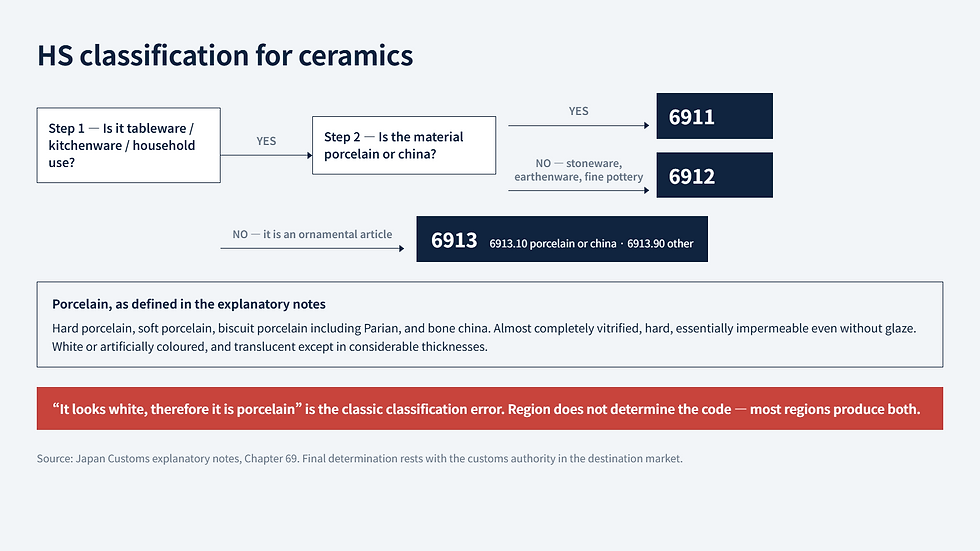
Fig. 6 — Source: Japan Customs explanatory notes, Chapter 69. Final determination rests with the customs authority in the destination market.
6911 — tableware, kitchenware and other household and toilet articles, of porcelain or china
6912 — the same articles in ceramics other than porcelain or china: stoneware, earthenware, fine pottery
6913 — statuettes and other ornamental ceramic articles (6913.10 porcelain or china, 6913.90 other)
The definition of porcelain is set out in the explanatory notes: hard porcelain, soft porcelain, biscuit porcelain including Parian, and bone china. These are almost completely vitrified, hard, and essentially impermeable even without glaze. They are white or artificially coloured, and translucent except in considerable thicknesses.
Three practical points:
The porcelain-versus-earthenware line is not determined by region. Most regions produce both. "It is Arita, therefore 6911" does not hold
"It looks white, therefore it is porcelain" is the classic classification error. Determination requires the material designation (porcelain, china, stoneware, earthenware), the production method, catalogue evidence and, where necessary, test data
Articles that are usable as tableware but sold as decoration are where 6911/6912 and 6913 are most often disputed
Duty rates follow from the destination and the HS code together. Where you intend to claim preferential treatment under an EPA or free trade agreement, a certificate of origin is required.
Fix the HS code with your customs broker or the destination customs authority before you order. Getting the number wrong produces unbudgeted duty and additional documentation at clearance.
Order quantities, lead times and price structure
Minimum order quantities
The floor is set by production model rather than by region.

Fig. 8 — Figures published by a Kutani OEM kiln. Costs vary by kiln, form complexity and specification. As of August 2026.
Kilns with production lines: a per-SKU minimum applies
Handwork-centred kilns: batches of tens to hundreds of pieces are normal. Counter-intuitively, lower-priced volume regions are the ones where minimums climb into the thousands
Made-to-order workshops: the unit is not quantity but how many pieces share one design
One-of-a-kind work: the concept of a minimum order does not apply
Where a mould is required, remember that a prototype mould stops producing usable pieces after roughly 30 units. If you expect to run 100 or more, commissioning a production mould is the rational choice.
Going through a wholesaler lowers the floor, because stock is already held, but raises the price.
Lead times
Published guidance from kilns and workshops gives the following order of magnitude.

Fig. 7 — Indicative figures published by kilns and craft workshops. Actual lead times vary by kiln, form, decoration method and season. As of August 2026.
Adding a name to an existing item, hand-written, small numbers: around two weeks
Decorating an existing form: two weeks to roughly two months
Producing from wheel-thrown forming: around six months
The gap between decorating an existing body and making the form from scratch is an order of magnitude, not a margin. Decoration involving gold or silver, where painting and firing repeat, extends it further. And because the work is divided among businesses, the waiting time at each handover accumulates.
Price structure
Between the kiln's ex-works price and your retail shelf price, the following accumulate.
Ex-works price from the kiln or workshop
Mould and prototyping costs, where a form is commissioned
Wholesaler margin, where one is used
Freight and insurance — proportionally high for ceramics, which are heavy, bulky, and require protective packing
Duty and clearance charges
Importer margin
Retail margin
We deliberately do not offer a multiplier. The figure varies too widely across product, destination, number of intermediaries, decoration method and shipping mode for any standard ratio to be useful.
What matters is running this calculation on your side first. Asking the kiln for a price and working forwards produces a number that does not clear. Work backwards from your target shelf price to the maximum ex-works price you can accept, then open the negotiation.
What to verify before you order
Supply
Whether the same design can be produced continuously, and for how long
Annual production capacity
How much of the division of labour your counterpart covers: forming, decoration, firing, packing
Peak season, and lead times during it
Quality
Whether a migration test report exists. If not, the number of samples required and who bears the cost
Tolerance for colour and dimensional variation between lots
Inspection criteria, and what counts as a defect
Whether glaze and enamel are identical between sample and production run
And one point that suppliers themselves disclose. A Kutani OEM kiln states plainly that ceramics are highly sensitive to material, firing conditions and the complexity of the form, and that even where design and prototyping present no problem, a production test may reveal a high risk of warping or breakage, leading to a judgement that stable continuous production is not feasible. In that case the kiln may propose substantial changes to the form or specification, or decline the work.
A prototype passing does not guarantee that production will. Since the supply side states this openly, treat it as an expected risk rather than an exception, and insert a stage between prototype approval and production order in which the production test result is reviewed. The more complex the form, the higher the risk.
Export capability
Whether there is export experience, and to which countries
Whether invoices and packing lists can be produced
Whether communication in English or your language is possible, and who bridges it if not
Commercial terms
Payment terms: advance payment, letter of credit, or open account
Incoterms: ex-works or delivered to port
Policy on breakage
Where a mould is commissioned, who owns it and whether it may be used for other customers
Rights in the design
Packing and breakage
Alongside regulation, breakage is the practical issue in ceramic sourcing. Agree the following before you order.
Individual packing: cushioning material, presentation box or not
Outer packing: cartons, pallets
Expected breakage rate and who absorbs it
Terms and lead time for replacement shipments
A presentation box is not transport packaging. For gifting it is part of the product's value, but it is not engineered as cushioning, and transport packing has to be specified separately.
Because the goods are bulky, freight is a high proportion of landed cost. Whether you consolidate to reduce it or raise unit price to absorb it is part of your pricing design.
Frequently asked questions
Which region should I start with?
Decide from your sales channel, not from the region. For fine dining, galleries and gifting, Kyoto covers the widest range. For commercial tableware in a permanent line, Arita. For highly decorative gifting, Kutani. Where you need continuous supply of the same SKU, Mino.
Why are lead times for Japanese pottery so long?
Because production is divided among separate businesses. In Kyoto a single piece moves between several craftspeople and several kilns, through forming, trimming, underglaze painting, glazing, overglaze painting and firing, with painting and firing repeated where gold or silver decoration is applied. Decorating an existing form takes two weeks to around two months; producing from wheel-thrown forming takes around six months.
Can one-of-a-kind pieces be sold overseas?
Yes, but the channel changes. They do not suit volume retail or e-commerce, where repeat supply of the identical item is required. In galleries, luxury hotels and corporate gifting, being one-of-a-kind is itself the value. Structuring the trade as made-to-order lets you carry no inventory risk.
Can I order in small quantities?
It depends on the production model rather than the region. Handwork-centred regions commonly produce in batches of tens or hundreds and can accommodate small orders. Regions producing lower-priced volume goods are the ones where minimums reach the thousands. The intuition that handmade means large minimums is backwards.
What does an original form cost?
A mould cost applies. Published guidance from one kiln quotes moulds individually from around JPY 50,000, notes that a prototype mould stops producing usable pieces after roughly 30 units, and recommends a production mould for runs of 100 or more rather than repeated prototype moulds at JPY 20,000 or more per set. Decorating an existing form carries no mould cost.
What testing is required to import ceramics as tableware?
Lead and cadmium migration must meet the destination's requirements. The United States applies FDA CPG Sec. 545.450 for lead and Sec. 545.400 for cadmium, with action levels by item class. The EU applies Directive 84/500/EEC, with limits by class and a written Declaration of Compliance. Taiwan applies its Sanitation Standard for Food Utensils, Containers and Packaging. Malaysia's Food (Amendment) Regulations 2026, in force from 1 August 2026, set lead at 0.5 mg/L and cadmium at 0.05 mg/L with a minimum of four test samples. Singapore sets no numerical limits, only a general prohibition.
Singapore has no numerical limits. Does that mean no testing?
No. Regulation 37 of the Food Regulations prohibits the migration of injurious substances in general terms without specifying limits. Because the basis for judging compliance is not written down, the importer must be able to demonstrate safety on its own responsibility. Testing against an internationally accepted standard such as EN, ASTM or ISO and retaining the report is the practical approach. Note also that importers must register with the SFA in advance and that all imported food-contact materials are subject to inspection.
How is the HS code determined?
By material and use in combination. Porcelain tableware falls under 6911, stoneware and earthenware under 6912, and statuettes and ornamental articles under 6913. It is not determined by region, and most regions produce both porcelain and non-porcelain ware. Judging by colour is a common error. The final determination rests with customs, so fix the code with your broker or the destination authority before ordering.
If the prototype is good, will production match it?
Not necessarily. Ceramics are sensitive to material, firing conditions and the complexity of the form. A prototype can pass while a production test reveals a high risk of warping or breakage, at which point the kiln may propose substantial changes to the form or decline the work. Build a review of the production test result into the process between prototype approval and production order.
What happens if items arrive broken?
This is something to agree before ordering. Include the expected breakage rate, who absorbs it, and the terms and lead time for replacement shipments. Where you are supplying commercial users who need continuity, the ability to replace an identical piece becomes an operational requirement.
Sources
Mino production share: METI Economic Structure Survey (2021) and Industrial Statistics (2019, 2013)
Kyoto handmade proportion and division of labour: Association for the Promotion of Traditional Craft Industries
Kyo and Kiyomizu ware production process: Nishikawa Teizaburo Shoten; Kiyomizu-yaki Danchi Cooperative
Arita exports to Europe: Government of Japan, Highlighting Japan
Kutani mould and decoration costs: published OEM guidance from Kutani kilns
Arita small-batch capability: published OEM guidance from an Arita supplier
Lead times: published guidance from kilns and craft workshops
United States: FDA CPG Sec. 545.450 and Sec. 545.400
European Union: Council Directive 84/500/EEC, Commission Directive 2005/31/EC, Regulation (EC) No 1935/2004
Singapore: Sale of Food Act (Cap 283), Food Regulations Reg. 37
Malaysia: Food (Amendment) Regulations 2026 (P.U. (A) 48), Food Act 1983
HS codes: Japan Customs explanatory notes, Chapter 69
Link Global supports Japanese manufacturers and craft producers in building overseas sales channels, and works with overseas buyers sourcing from Japan. If you are evaluating Japanese ceramics for your market, get in touch.


コメント